
How Physical Therapy Plays Into
Your Parkinson’s Care Plan
By Megan Lloyd, PT, DPT, LSVT BIG, Certified
What is Parkinson’s Disease?
Parkinson’s disease is a progressive movement disorder of the nervous system, most often diagnosed in people in their 60’s. The condition disrupts dopamine production, which the body needs for purposeful movement. When dopamine levels drop, individuals experience symptoms such as tremors, impaired balance, and slowed movement (bradykinesia). As symptoms progress, people with Parkinson’s disease may struggle with walking, talking, and completing everyday tasks. Research shows that exercise positively affects individuals with Parkinson’s, helping improve function and quality of life.
Parkinson’s by the Numbers
According to the Parkinson’s Foundation, Parkinson’s disease affects more than 1.1 million people in the United States, with nearly 90,000 new cases diagnosed each year. The condition becomes more common with age and affects men about 1.5 times more often than women, with higher prevalence seen in regions such as the Rust Belt, Southern California, and Florida. Annual U.S. healthcare costs related to Parkinson’s approach $61.5 billion, highlighting the importance of continued research, improved access to care, and advances in treatment. 
The LSVT Big and Loud Program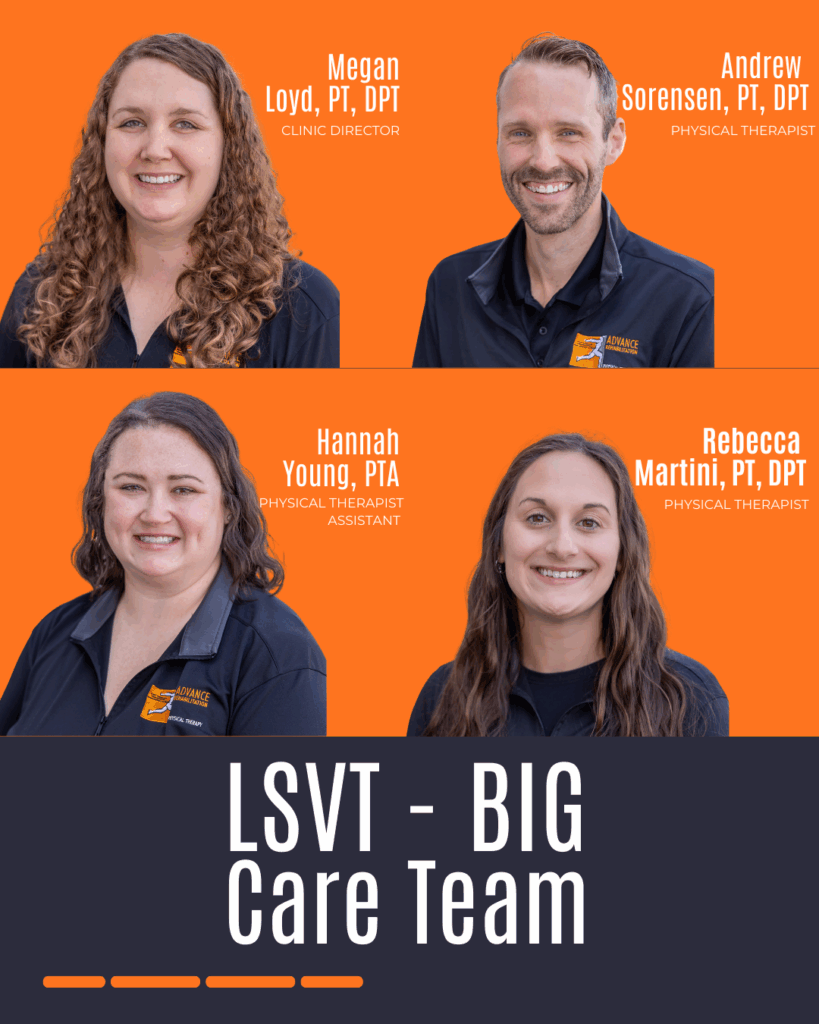
LSVT BIG and LOUD is a program designed to address the most common challenges associated with Parkinson’s disease, and physical therapists, speech therapists, or occupational therapists can deliver it. LSVT stands for Lee Silverman Voice Treatment, named after Lee Silverman, a woman living with Parkinson’s whose experience inspired the program.
Speech therapists typically lead the LSVT LOUD portion, while physical therapists incorporate select LOUD elements into the BIG protocol. At Advance Rehab’s Calhoun clinic, most therapists hold LSVT BIG certification and have completed 12–16 hours of Parkinson’s-specific continuing education
The Protocol
The patient participates in 16 sixty-minute treatment sessions, scheduled four times per week for four weeks. During these sessions, the therapist guides the patient through seven repeated exercises (also completed at home), five simple daily tasks, and one to two hierarchy tasks, which include multi-step activities such as car and bed transfers.
The sessions emphasize therapist demonstration and BIG amplitude movements to promote effective motor learning. The program aims to recalibrate movement for bradykinesia, addressing the slow, small movements commonly seen in Parkinson’s disease. Although the program primarily serves individuals with Parkinson’s, therapists also use it to treat other neurological conditions, including stroke and multiple sclerosis.
The Benefits
Patients report improvements in daily activities such as writing, dressing, transfers, and walking. In addition, leg strength and posture improve, allowing patients to walk faster, take larger steps, and maintain better balance. Importantly, the LSVT BIG program benefits individuals at any stage of Parkinson’s disease, including early onset, and can help slow disease progression.
If you or a loved one has Parkinson’s and mobility challenges, ask your doctor about an LSVT BIG referral. For additional resources, visit LSVT Global or contact our Advance Rehab’s Calhoun clinic, Georgia clinic at 706-625-0662 to learn more.