By Rebecca Martini, PT, DPT
What is dryland, you may ask?
To runners, cyclists, golfers, and football players, the land is always dry—so that might sound silly. But to swimmers, dryland is that dreaded workout you must do outside the pool, after practice, on land, and far from the comfort of water.

Rebecca Martini, PT, DPT, is a physical therapist at our Calhoun, Georgia clinic who specializes in treating swimming-related and other orthopedic injuries.
I didn’t always work on dryland, but hey—you can’t swim away from paying bills. I was a competitive swimmer from age 6 to 22. What began with summer league races in Augusta led to year-round club meets, and eventually a scholarship to swim at the Division I level. I swam for and graduated from the University of Nebraska Omaha in 2021 (Go Mavs!).
Swimming gave me the opportunity to compete across the country and meet incredible athletes at every level. It’s a unique sport—not just in the strokes and pool lengths, but in the way every swimmer moves. You’ve got four strokes (butterfly, backstroke, breaststroke, freestyle), and two pool lengths (short course 25 yards, long course 50 meters—Olympic style). Depending on your body type, stroke specialization, and race distance, your technique can and should vary. It’s all about body mechanics.
MySwimPro offers clear, detailed descriptions of all four swim strokes, explaining their mechanics and the importance of understanding each one. But even with ideal technique, swimming isn’t injury-proof. Like all sports, it takes a toll. And that’s where physical therapy—yes, on dryland—comes in.
Why Do Swimmers Get Shoulder Pain?
If you’re around swimmers long enough, you’ll hear: “My shoulder hurts.” And they’re probably not exaggerating.
According to the Science Direct, “Competitive swimmers experience shoulder injuries at a high rate, with studies reporting that 23% to 51% of swimmers experience shoulder-specific injuries, and 26% to 41% of injuries are shoulder-related. Additionally, 74% of swimmers reported experiencing shoulder pain, with 23% reporting a shoulder injury. This indicates that shoulder injuries are a significant concern among competitive swimmers”.
The average high school swimmer trains about 5,000 yards per day, 5 days a week. That’s 200 lengths in a short course pool. With around 12 arm strokes per length, that’s 1,200 arm movements—per arm, per day. Add in strength training and dryland workouts, and you’ve got a recipe for overuse.
One of the biggest contributors? Posture. Swimming encourages rounded shoulders—especially in butterfly and breaststroke. Combine that with weak rotator cuff or postural muscles, and you get:
Subacromial pain syndrome (shoulder impingement)

Subacromial impingement syndrome happens when soft tissues in your shoulder—like a tendon or a fluid-filled sac—get pinched under a bone at the top of your shoulder when you raise your arm.
Proximal Biceps Tendonitis
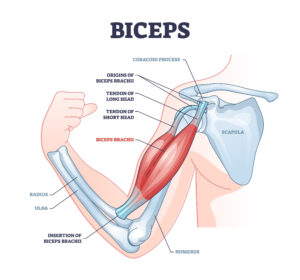
Proximal biceps tendonitis is an inflammation of the long head of the biceps tendon, often caused by overuse or wear and tear, leading to pain in the front of the shoulder.
Another big one—especially in younger swimmers—is Multidirectional Shoulder Instability. Some swimmers, like Michael Phelps, have incredible shoulder mobility and control. But many young swimmers simply stretch more because they feel loose, without balancing that mobility with strength. The result? Weak stabilizers that can’t keep up with the demands of high-rep swimming and growing bodies. That can lead to shoulder, scapular, and even neck pain.
What Helps?
- Outside the Pool: Focus on controlled mobility, not just stretching. Strengthen your rotator cuff and back muscles. Use good warm-up routines.
- In the Pool: Ask your coach for stroke feedback. Try subtle stroke changes that better suit your body dynamics.
Let’s Talk About the Back
Take butterfly, for example. During this stroke, swimmers use simultaneous arm movements paired with the dolphin or “mermaid” kick. Male swimmers may have the strength to drive through the water despite their body angle. But for many female swimmers—who may not generate the same force—body position becomes even more critical.
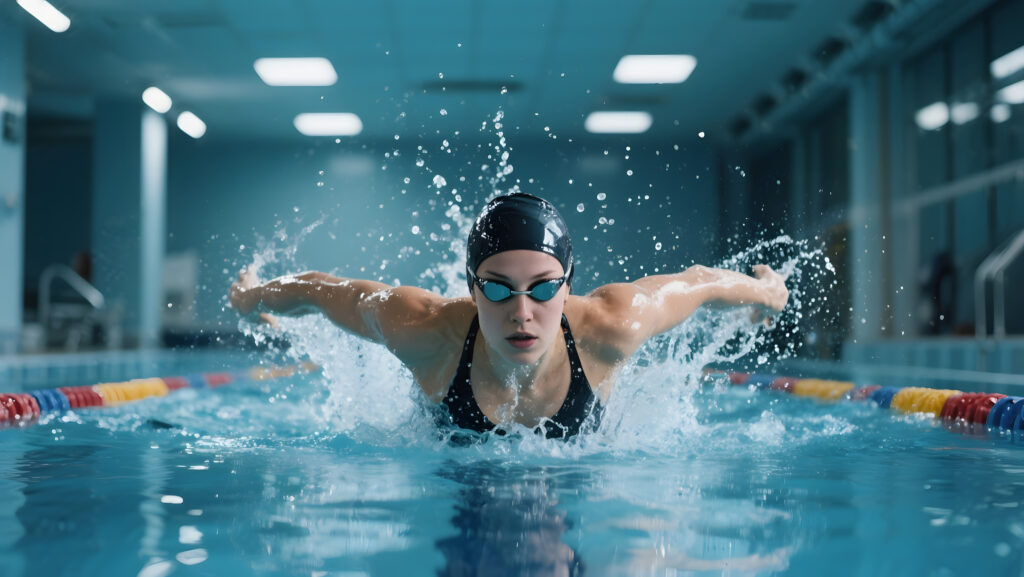
If a swimmer’s hips sink too far below the surface, they create a steeper angle between the head and hip, stressing the lower back. This creates a lordotic posture—an exaggerated curve of the lower spine—which can place strain on joints and ligaments.
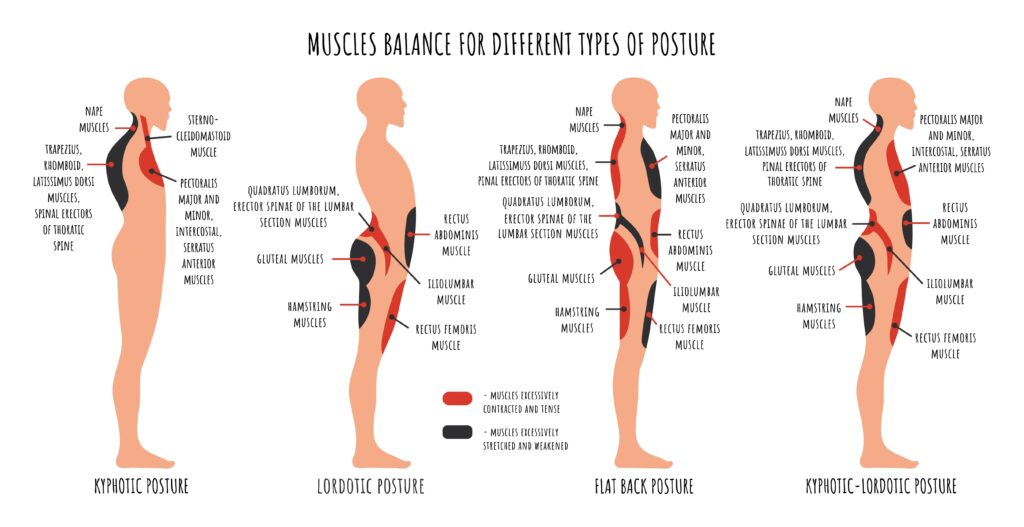
Comparison of muscle imbalance in various postural disorders. Kyphotic, lordotic, flat back posture infographics. The side view shows characteristic stretched and weakened, shortened and tens muscles
But this issue isn’t exclusive to butterfly specialists. Swimmers often perform butterfly kicks off the wall—3 kicks per turn is common. Multiply that across 5,000 yards in a short course pool, and you’re doing 600 kicks per practice. Without proper core and hip stability, that’s a lot of uncontrolled movement and risk to your lumbar spine.
What Helps?
- Dryland Work: Train core stability and hip control. Strengthen what supports your spine.
- In-Water Drills: Practice head and body position that reduces back stress. Fun fact: some female butterfly swimmers breathe to the side instead of forward to keep hips from dropping too low.
Everyone Is Different
That’s the magic and challenge of swimming—and rehab. No two swimmers move exactly the same, so no two treatment plans should be identical. As we grow and age, the way we care for our bodies needs to evolve too.
Whether you’re still swimming competitively or you’re now a full-time “drylander” like me, remember: what you do out of the pool directly impacts how you perform in it. Don’t skip your dryland—your future self (and shoulders) will thank you.
If you would like to schedule an appointment at any one of your Advance Rehabilitation Clinics, please feel free to reach out by clicking on the clinic information below.